

President's Corner
President’s Message
April 2026
Dear fellow ISEE members –
Hope you are all enjoying the days of April. In North Carolina, where I live we are covered in green pollen but enjoying the beautiful flowers on trees and bushes around town. The weather has been a roller coaster, with cold temperatures longer than usual and now we are in the midst of a heat wave. These warm temperatures make me think of the summer that is coming.
Looking towards August and September, I am getting my plans in order to travel to Munich. Although I have been to Germany a few times, I haven’t spent much time in Munich and I am looking forward to it. I want to thank Drs. Annette Peters and Alexandra Schneider and their local organizing team for all of the hard work that they have been doing to get ready for us to enjoy our 38th Annual Conference.
As the program is being formalized, I just want to highlight a few exciting things on the agenda that I am looking forward to. This year there are 30 symposia on the program. I really enjoy symposia because you can get a good overview of an important topic by listening to a number of experts all building on salient components of the bigger problem. This year they cover a wide range of contemporary topics in environmental epidemiology. There are 12 symposia that cover important aspects of climate, weather, and planetary health related topics. We will also be treated to up-to-date evidence on impacts of air pollution in heavily exposed regions. None of this is surprising to me since our ISEE members are world leaders in conducting research on the health impacts of climate change and air pollution.
Several of our Scientific Interest Groups have submitted sessions on pesticides, impacts of war and conflict, how noise affects our health, and a methodological discussion of bias in environmental epidemiology studies. Talks about conducting research with a focus on quantifying impacts of our exposome will also be featured. We will hear from leaders in the fields of data integration and artificial intelligence, topics which impact all of our work. Symposia will discuss global impacts of PFAS studies, lead poisoning prevention, and more. Our colleagues will give us a historical perspective of the long-term health impacts 40 years after the Chernobyl disaster and a look toward to the future of research on impacts of radiation exposure. It is going to be hard to choose only one symposium each day to attend since they all look so enticing.
I also want to remind you that there is a robust list of training workshops available for those who want to learn new methods, dig into new statistical tools to apply to your work, or learn more about our environment by listening as part of the CitySoundScapes program. I encourage you to sign up soon, before they all fill up.
Remember early bird registration closes on April 30 and you’ll want to grab a ticket to the Conference dinner at the Löwenbräukeller in the Center City of Munich. Our annual conference dinner is an excellent way to enjoy the culture of the city where we are convening, enjoy the company of your ISEE colleagues from around the world and maybe even dance the night away.
Hope to see you all very soon in Munich –

Gwen
President’s Message
March 2026
As I think about ISEE’s strategic plan for 2025-2028, one of our goals (Goal 2) is to carefully manage ISEE resources to ensure economic resilience, sustainable growth, and the continuity of existing initiatives and the possibility of adopting new ones. As we approach our 40th anniversary as a scientific society, creating ways to assure our financial stability is not an aspiration, but an obligation if we want to flourish in the future.
With our leadership team, I am working to align our budget planning process with our strategic goals. As part of this process, one thing I think is important is to be transparent about our budget and spending with our members. For everyone to understand how we operate, I’d like to enhance our collective financial literacy as it pertains to the ISEE budget process.
With that goal in mind, I want to introduce our new Secretary/Treasurer, Dr. Tamara Schikowski, who will be playing an important role in assuring the fiscal health of ISEE. Tamara and I have collaborated on this month’s President’s message.
Tamara Schikowski was elected in 2025 to serve as Secretary/Treasurer from 2026 to 2028. Tamara knows a lot about the ISEE budget. One of the biggest factors affecting the ISEE budget is the cost of the Annual Conference. Tamara has been co-chair of the Annual Conference Committee for many years and served as a member of the committee since 2017. Tamara was elected to the ISEE Fellows in 2025. Tamara is a professor at the School of Public Health in Bielefeld. She is also the head of the Environmental Epidemiology Working Group at the IUF Leibniz Research Institute for Environmental Medicine in Düsseldorf, Germany. She has been a member of ISEE since 2012. She has helped organize the annual conference in Basel and Sydney.
We are taking this month’s slot to discuss ISEE finances because this time of year is budget planning season for ISEE.
ISEE’s fiscal year runs from July 1-June 30, and we are in the middle of our current fiscal year. When we provide our annual financial report at the Annual General Meeting at the ISEE Conference in Munich this August, we will be presenting the figures and reports from this current fiscal year. Today, we will be using figures from our previous fiscal year as we talk about our budgeting.
The past several years, ISEE has purposely operated with a deficit budget. For example, in the most recent fiscal year, ISEE had income totaling $306,248, and expenses of $373,513. This resulted in a deficit of -$67,265. The Council has chosen to plan to spend more money than we make, to provide funding for various initiatives. We have been able to do this because ISEE ran successful virtual conferences in 2020 and 2021 and received considerable profit from both conferences that has supported ISEE activities in recent years. Because ISEE sustained a large profit in 2020 and 2021, the Council instituted a financial reserve policy that requires ISEE to maintain one year of operating expenses in our financial reserve. This equates to roughly $400,000. At the end of our most recent fiscal year (June 30, 2025), ISEE had a total equity of $672,620, which met our policy of maintaining operational expenses in reserve, and then some. This policy was instituted during the COVID-19 pandemic, when there was considerable uncertainty if ISEE could survive the shocks of the pandemic. By maintaining a year’s operating expenses in financial reserve, ISEE can be sure that it can withstand world events that may impact membership and conferences and continue to provide services and support to our members during those times. It also helps us manage cash flow during the year, as we pay for our activities including deposits or other expenses related to our annual meeting that are due before we receive income from the conference.
Much of our income comes from membership dues. In fact, two-thirds of ISEE’s income came from membership dues ($202,871) in the most recent fiscal year, coming from about 2000 members. The remainder of ISEE income came from conference proceeds, interest, and donations. ISEE is fortunate to have two donor-funded programs that support activities: the Dan Wartenberg Memorial Fund, and the Dan Greenbaum Memorial Keynote lecture.
The Dan Wartenberg Memorial Fund honors Dan Wartenberg, who served as ISEE Secretary/Treasurer from 1997-1999 and was ISEE’s ninth President, who was committed not only to his methodological research on identifying disease clusters from random occurrences but also to responding to requests for help from citizens concerned about disease in their communities. This fund supports researchers, projects, and initiatives that help further our understanding and engagement with community-engaged environmental health science. Since its inception in 2022, this fund has supported over 40 researchers to participate and present at the ISEE Annual Conference. We are grateful to his widow, Dr. Caron Chess, who helps keep Dan’s values and vision of community-engaged environmental health science a bedrock of ISEE activities.
The Dan Greenbaum Lectureship Fund sponsors an annual plenary lecture at the ISEE international conference aimed at inspiring innovation and progress at the intersection of science and policy to improve public health. Launched in 2025 through the support of his family, the inaugural lecture, “Air Pollution Epidemiology: Promises and Challenges” was delivered at the ISES-ISEE Joint Conference by C. Arden Pope III. We are thankful to Dan Greenbaum’s friends and family who fundraised to sustain this lecture on the conference program for the next several years.
On the expense side, when thinking about ISEE’s operational expenses, $400,000 may sound like a large number. I’d like to go into detail a bit more on what those expenses are. A major factor of our budget is the Annual Conference. The total conference budget in 2025 was $1,291,292.55. ISEE received a profit of $42,021.08 from the 2025 conference.
In ISEE’s most recent fiscal year, our largest expense was about $140,000, which was for Secretariat management and support. The Secretariat is responsible for the day-to-day operations of ISEE, including membership management, website updates, financial oversight, and more. I am happy to share that we have negotiated a new contract for Secretariat management with Bocere Group, that reduces our annual fee to $120,000. With this contract, the Secretariat will include all chapter and committee administrative support, whereas before ISEE had to pay for that separately on an ad-hoc basis. This new contract will allow ISEE to invest in other initiatives and gives ISEE certainty on the yearly cost for Secretariat support.
Our annual budget includes funds for each Chapter and Committee for their initiatives that align with ISEE overall strategic goals. This money is used to provide travel funds, waivers for membership and meeting registration, support regional conferences, and other pursuits. This gives our members the opportunity to carry out activities at the local level. This was the second largest expense during the 2024-2025 fiscal year, coming in at $82,000. This year, ISEE is creating a new finance committee that will support the financial oversight, sustainability, and strategic financial planning of ISEE. The committee has been designed to include one representative from each chapter, so that chapters have greater input in the budgeting process moving forward. This committee will help improve the financial literacy of our members and introduce more chapter members to the operations of the society to help prepare them for future leadership opportunities.
Our third largest expense, both in the recent fiscal year and in the past few years, has been travel awards. Beginning in 2022, ISEE began investing more in travel awards to the international conferences, with a goal of investing $80,000 in travel awards each year. ISEE was able to successfully do this in 2023 and 2024 and was able to more than double the number of members we were able to provide financial support to facilitate their attendance at the conference. While we had to reduce funding in 2025, we aim to go back to $80,000 in direct financial support in 2026.
As we look to our next fiscal year which will begin on July 1, 2026, we will be taking into consideration the ISEE Strategic Plan and determining how we should budget to fulfill the priorities identified in the plan.
If you’d like to learn more about ISEE’s financial performance, I encourage you to review the Annual Reports from each year, available on our website. I hope to see many of you at the 2026 AGM, where we will present on this year’s activities, and discuss our plans and budgeting for the next fiscal year. As always, I would love to hear from you at president[at]iseepi.org and I’d be happy to answer any questions you have about our fiscal health, our strategic plan and our budgeting process.
Best,

Gwen and Tamara
President’s Message
February 2026
As I've connected with various ISEE members, I have been impressed and inspired by the incredible work our members do on a daily basis. This goes beyond research and science: our members are leaders, paving the way for ethical science, and consistently standing up for environmental epidemiology and our community. There is no better way than for us to showcase and celebrate these efforts than through our annual ISEE Awards.
This is the time of year when ISEE is inviting nominations for our annual awards, and I'd like to encourage you all to consider submitting nominations for one of our awards. We have awards available for all career levels: for those that are early in their career, think about someone for the Rebecca James Baker Award. This award highlights an early career investigator who embodies a commitment to environmental epidemiology as a tool for improving public health and quality of life.
We also have the Tony McMichael Mid-Term Career Award, which honors mid-career scientists who demonstrate excellence in environmental epidemiology, and are dedicated to mentoring and community engagement. As recognition for outstanding scientific contributions and impacts across a successful career, we have the John Goldsmith Award. The winner of this award delivers a keynote lecture at our annual conference. If there is someone you'd like to hear from, consider nominating them for this esteemed award.
Beyond these career awards, ISEE has additional awards to honor excellence from our members. Though not awarded every year, an award not to overlook is the Research Integrity Award. We recognize that members of our community may have to stand up to special interests or other external pressures as you pursue and advocate for your research. The Research Integrity award is a way to recognize and celebrate those who have had to persevere in pursuit of science.
ISEE members are also welcome to submit nominations for the Best Environmental Epidemiology Paper Award. The BEEP award is not only a way to highlight outstanding papers published in 2025 by you or your colleagues, but also the opportunity to showcase the future directions of research in the field.
Finally, I am especially partial to the ISEE Fellows Award. This is one of our newest awards, and it showcases long-term ISEE members and their achievements as environmental epidemiologists impacting research, training, community engagement, translation or policy. This award also recognizes excellent sustained service to ISEE and is a way to recognize our colleagues who lead in many ways. Becoming am ISEE fellow helps us recognize your efforts and their importance to ISEE. I am a proud ISEE Fellow, and I hope many of you apply this year. One of my priorities as President is to grow the cohort of ISEE fellows and deepen the ties between the Fellows and ISEE. As part of our strategic planning, ISEE leadership has been discussing new ways ISEE fellows can connect with our new and younger members, share guidance on professional development, and help build networks and connections between the membership. If this sounds like something you'd like to support, nominate yourself or your colleagues today.
Nominations for all awards are due March 15, and you can find more information here: https://www.iseepi.org/awards.php
I look forward to recognizing the talents and contributions of our members through this year’s awards. ISEE has much to celebrate as a global scientific society, our awards and recognitions are one way to honor and pay tribute to those scientists who came before and to those who will help us lead the way into the future. I am already looking forward to celebrating all of our honorees at the ISEE conference in Munich.
Best,
President’s Message
January 2026
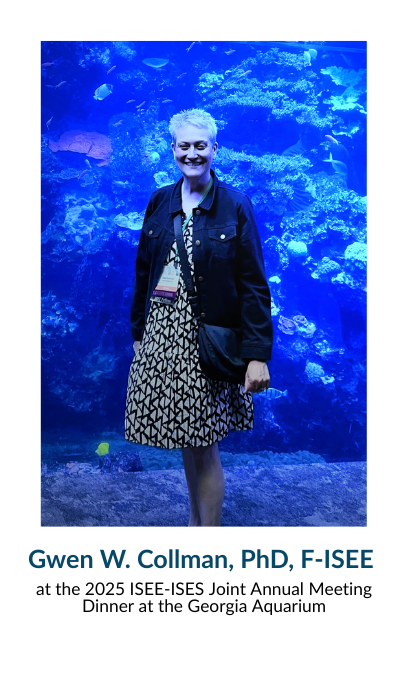 I am honored to write my first President’s Message to kick off our ISEE 2026 newsletters. For those of you who may not know me, let me introduce myself. I have been an ISEE member since the organization began. I actually attended the first meeting where the idea for ISEE was born in 1987. I spent my career at the National Institute of Environmental Health Sciences (part of the US National Institutes of Health). During those 40 plus years, I held a succession of positions where I led programs that help to foster and grow the field of environmental epidemiology in the US and around the world. Through the direction and stewardship of the environmental epidemiology and then more broadly the entire extramural research and training portfolio in public health, environmental health, toxicology and related science, I was able to work with scientists at all career levels, many of whom are members of ISEE. In my final years at NIEHS, I led the NIH Climate Change and Health program from the Office of the Director and led efforts to create the strategic plan for NIEHS for 2025-2029. In March of 2025, I retired from US Federal service and became part of the elected leadership of ISEE. I am thrilled to have the time and energy to devote to a society that has been my professional home, to maintain relationships with friends and colleagues I have known for decades and to create new relationships with our members across our chapters.
2025 has been a year of learning and listening for me as I connected more closely to the work of our Society. I learned so much about the different facets of our work and the many ways that our volunteers give their time tirelessly to develop and promote the various activities of ISEE. I have been delighted, and also overwhelmed, with the commitment and devotion that so many of you have to ISEE. Each month, through webinars, chapter and committee meetings, Special Interest Groups, and meetings of the ISEE Executive Council, our members connect on-line or through email and social media to discuss a variety of different issues important to you, your work, and our field. ISEE has grown substantially over the last decade, and there have been some growing pains. I hope to use my experience in organizational change management and governance to help create a stronger ISEE that can withstand future pressures. We have witnessed attacks on our science, funding, and the practice of public health in the last year which have caused stress for many members. As we create a resilient ISEE, I would like us to be ready to face the future.
With the launch of our new strategic plan this year, I encourage you to delve into it and see where you and your work fit in. I hope that our goals and many of the ideas that we have to achieve them resonate with you. You can read our strategic plan here: https://www.iseepi.org/strategic_plan.php
I believe that an organization’s Strategic plan should be a living document that reflects the priorities of its members. It isn’t just a document that we write to fill a space on the web, but something we use as a guide for activities and actions over ISEE's life span. Early in 2026, the Executive Council, together with the Chapter and Committee chairs, will meet to discuss the plan in detail and spend time aligning our current activities with the goals. We will also do a deep dive into the many items listed in the plan that we want to accomplish over the next 5 years and strategize on how to implement them. This will include establishing some metrics to measure our accomplishments over each year. We will be gathering data on what we accomplish and I’ll be sharing updates on our progress periodically.
In closing, I’d like to share my gratitude to those of you who helped me get my footing last year in order to feel prepared to lead ISEE as your President. I can’t thank Nelson Gouveia and Michelle Turner enough for sharing information and perspective on so many issues and giving me a strong sense of the history of ISEE. As President-Elect, I had the luxury of asking many, many, many questions so that I could grasp the nuances of our organization, it’s policies, procedures, and culture. I was lucky to be able to learn from two people that have served the Society well. They were generous with their time and welcomed, or should I say, put up with what might have seemed liked endless questions. A great thanks to both of them for their incredible service to ISEE. I’d also like to give a big thank you to Kathryn Salucka who led our Secretariat as the account manager at Infinity Conference Group. She and her staff were unbelievably responsive to all of my questions and requests. I’d also like to announce that ISEE underwent a rigorous search process this fall to select a new company to manage our Society. The contract was awarded to Bocere Group on January 5, 2026, to lead operations as the ISEE Secretariat in 2026. I am delighted to share that Kathryn Salucka is the CEO of Bocere Group and so I am confident that we will have a smooth transition and not lose any momentum.
I would like to thank all of you who have welcomed me into this new role. Those who have taken time for 1:1 calls, catch up conversations at the August conference, and for emails sent over the year. As your President, I am anxious to connect with as many of you as possible and engage in dialogue about issues that you care about. I am available by email when you’d like to share your thoughts, your successes, and your concerns as the year goes on. You can reach me at president[at]iseepi.org and you can be sure that I will get back to you for further discussion. I hope that 2026 will be an engaging and vibrant year at ISEE and I look forward to working with all of you and seeing you at our annual conference in Munich in August.
Best,